
Movement
The Movement panel holds what TockPilot builds. With a movement selected, it shows that movement’s settings, headed by its name: change one and TockPilot rebuilds it in place. With nothing selected, it is headed Next Movement and sets what Add Movement builds.
The panel shows only the settings the style has. A watch has a dial and a balance, a clock has a pendulum.
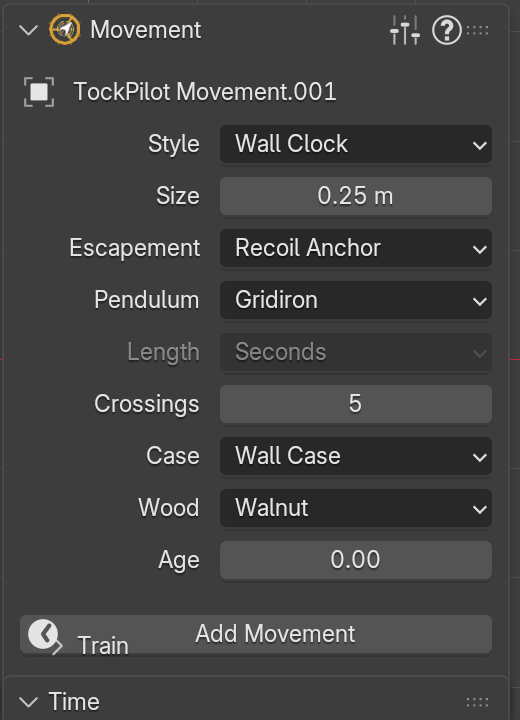
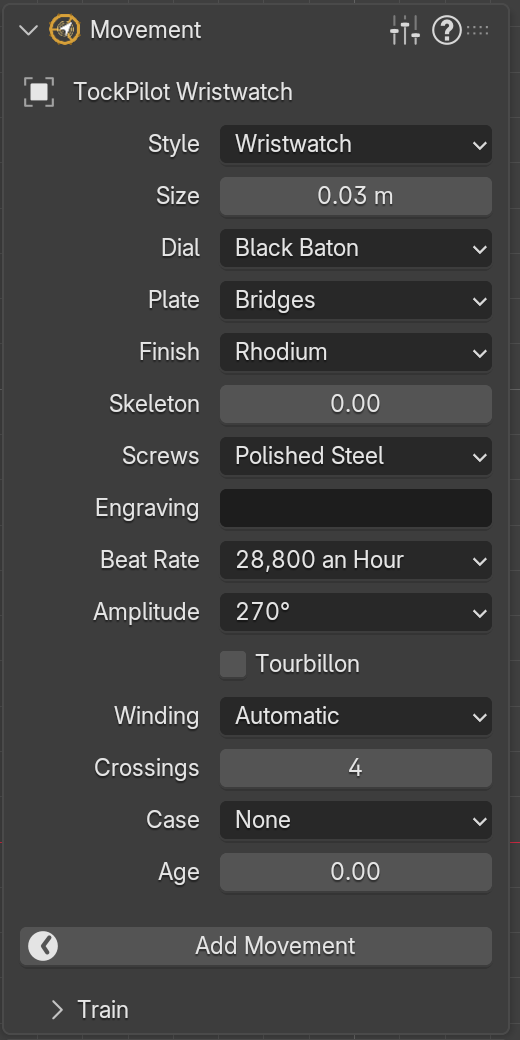
The kind of movement. Each keeps time over 12 hours and meshes cleanly at every tick.
- Wall Clock: a regulator with a seconds pendulum.
- Skeleton Clock: the regulator on an open frame, so its train shows from both sides.
- Tower Clock: a flatbed turret movement with a 1.5 second pendulum. A leading-off rod turns the hands of a large dial above it.
- Pocket Watch: a Swiss lever at 18,000 beats an hour, a large balance, small seconds at 6.
- Wristwatch: a Swiss lever at 28,800 beats an hour, small seconds at 9.
A clock’s width, or a watch movement’s diameter. Each style starts at its real size: 25 cm for the clocks, 90 cm for the tower clock, 45 mm and 30 mm for the watches. Change it to fit your scene; every part scales with it.
A watch’s face, with its hands: Roman Enamel with blued Breguet hands, Arabic Silvered, or Black Baton with steel batons.
How a watch’s wheels are held. Bridges gives each wheel its own bar, so the wheels show between them, as on Swiss movements. Three-Quarter Plate covers the barrel and train with one plate and sets the balance in a bay, as on Saxon watches from Glashütte.
Finish
Section titled “Finish”The finish of a watch’s bridges or plate. Rhodium has Côtes de Genève stripes, the modern Swiss look. Frosted Gilt is the warm gold of 19th-century watches. German Silver is the pale, untreated metal of Saxon plates.
Skeleton
Section titled “Skeleton”How much of a watch’s plate and bridges TockPilot cuts away, so the wheels show through. At 0 they stay whole. Metal always stays round every jewel, screw and pillar. From 0.5 the dial opens to a chapter ring.
Screws
Section titled “Screws”The screw heads: Polished Steel, or Blued Steel, the deep blue of fine watches.
Engraving
Section titled “Engraving”A name engraved on the barrel bridge or the three-quarter plate, and on an automatic’s rotor. Up to 24 characters. Leave it empty for none.
Beat Rate
Section titled “Beat Rate”How often a watch’s balance beats: 18,000, 21,600, 28,800 or 36,000 an hour. TockPilot changes the fourth wheel and the escape pinion with it, so the seconds hand still turns once a minute. At 36,000 the seconds hand sweeps almost smoothly.
Amplitude
Section titled “Amplitude”How far the balance swings each way, from 200° (a watch nearly run down) to 300° (a fresh watch at full wind). The beat rate stays the same.
Tourbillon
Section titled “Tourbillon”Tick it and TockPilot carries the escapement and the balance in a cage that turns once a minute. A tourbillon watch is hand-wound, so Winding is greyed out while it is ticked.
Winding
Section titled “Winding”How the wristwatch is wound. Hand-wound winds by the crown. Automatic adds a rotor that swings as on a wrist and winds the barrel through a reverser.
Escapement
Section titled “Escapement”A clock’s escapement. Graham is the deadbeat of precision regulators: the seconds hand stops dead between ticks. Recoil Anchor is the anchor of most house clocks: after each tick the wheel is pushed back, so the seconds hand steps back a little.
Pendulum
Section titled “Pendulum”The pendulum of a wall or skeleton clock: Rod and Bob, Harrison’s Gridiron of steel and brass rods, or Graham’s Mercury Jars.
Pendulum Length
Section titled “Pendulum Length”Shown as Length under Pendulum. Seconds is 994 mm and ticks once a second. Half-Seconds is 248 mm and ticks twice a second, as bracket clocks do; a reduction gear keeps the seconds hand at one turn a minute. Half-Seconds needs Rod and Bob and a case other than the Grandfather Clock, so the field is greyed out otherwise.
Crossings
Section titled “Crossings”The spokes of each train wheel, 3 to 6. Watches start with 4, clocks with 5. Open the Train sub-panel under Add Movement to see each wheel’s teeth and the pinion it drives.
What the movement stands in. The choices depend on the style:
- Watches: Gold or Steel with a crystal and a glass back, or Glass all round.
- Wall Clock: Grandfather Clock, Wall Case, or the wall case in Glass.
- Skeleton Clock: a glass dome on a Wooden Base or a Glass Base.
- Tower Clock: an Iron and Glass frame, or one all of glass.
The wood of a clock’s wooden case or base: Mahogany, Walnut, Oak or Ebony. TockPilot joins each case from separate boards, 49 on the grandfather clock, each with its grain along it.
How old the metal looks. At 0 it is new; at 1 it is dull and tarnished in patches. Age changes only the materials, so TockPilot applies it without rebuilding any part.
Add Movement
Section titled “Add Movement”Builds a movement at the 3D cursor. With a movement selected, it adds another with the same settings. With nothing selected, it uses the settings under Next Movement. Add Movement works in Object Mode; in another mode the button is greyed out and its tooltip says why.